
By Michelle DeVillier
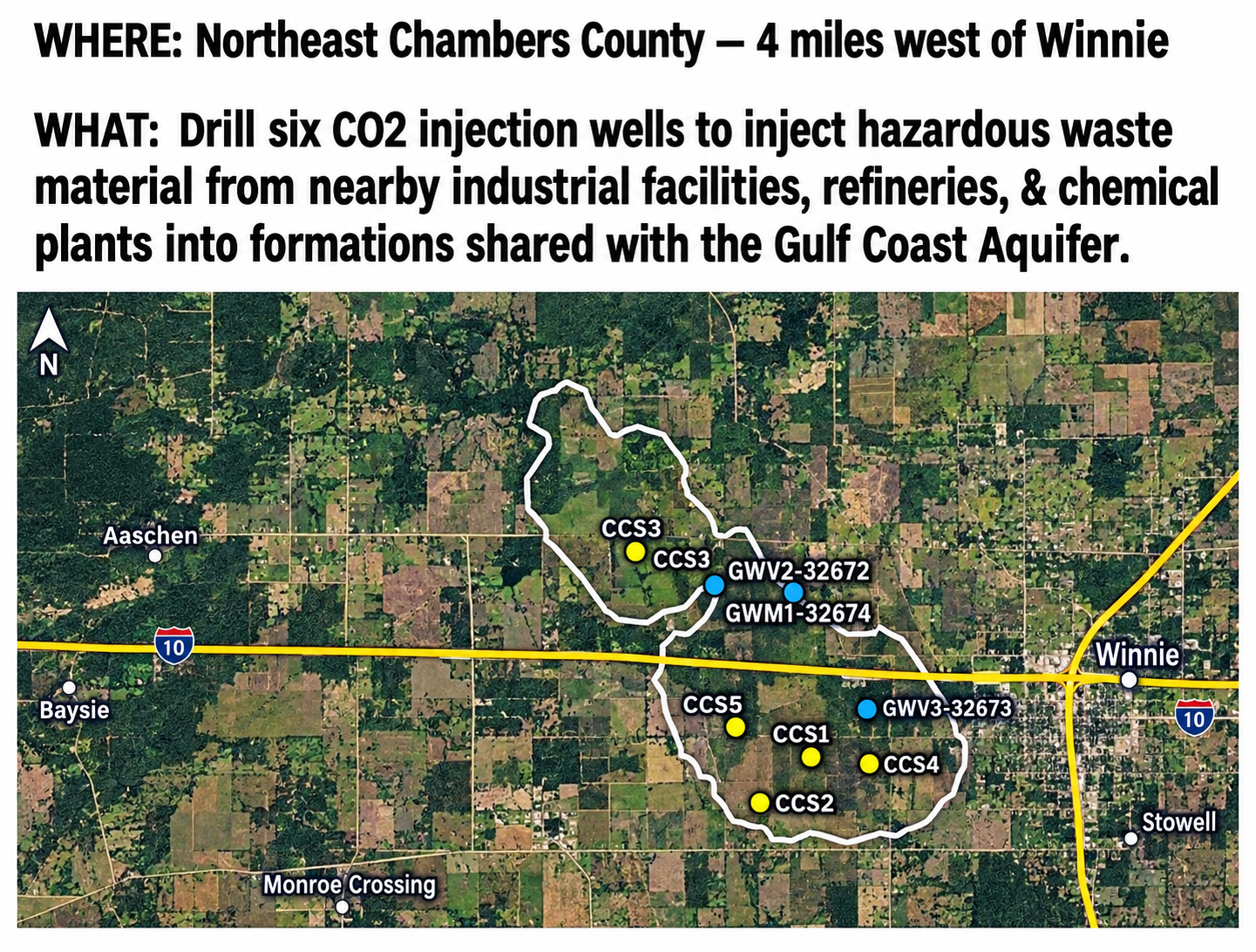
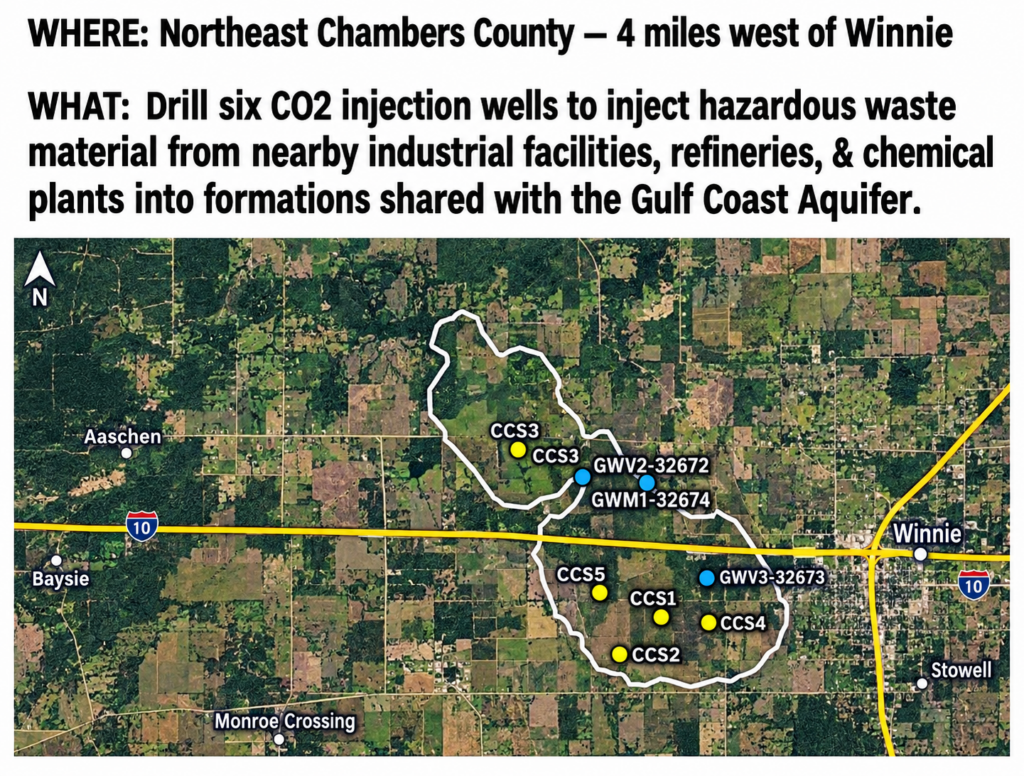
Four miles west of Winnie, Texas, a quiet agricultural landscape is becoming part of one of the largest experiments in carbon capture and storage in the United States. The proposed Bluebonnet Sequestration Hub would include six Class VI injection wells in Chambers County. The project proposes injecting approximately 1.31 million metric tons of compressed carbon dioxide every year for 20 years—more than 26 million tons during the initial injection period.
That makes Winnie more than a local permitting story. It is a window into a much larger transformation occurring across the Texas and Louisiana Gulf Coast.
The basic idea sounds simple. It isn’t. Carbon capture and storage, or CCS, is promoted to keep industrial carbon dioxide out of the atmosphere. A factory, refinery, chemical plant, LNG facility or other industrial operation captures CO₂ from its emissions. The gas is compressed and transported, generally by pipeline, to an injection site. It is then injected thousands of feet underground into porous geological formations. An impermeable layer of rock is supposed to keep it there.
But the system doesn’t simply make carbon disappear. It creates a huge new industrial network: capture plants, compressors, pipelines, injection wells, monitoring systems and decades of responsibility for what has been put underground. And carbon dioxide is not harmless simply because it is not flammable. At sufficiently high concentrations, CO₂ displaces oxygen and can cause unconsciousness and death. Because it is denser than air, a large release can accumulate in low-lying areas. That makes a major CO₂ pipeline rupture a very different emergency from a conventional natural-gas pipeline accident. Emergency responders face difficulties because a large CO2 release behaves differently from a conventional fire or gas leak.
Winnie adds another problem – flooding. The proposed Bluebonnet site is not located in an abstract geological laboratory. It is on the Gulf Coast, in an area with a history of major flooding. Properties associated with the proposed project flooded during 2017 and again in 2019. Flooding matters because CCS is not only an underground operation. The project depends on surface infrastructure—including wellheads, pipelines, electrical equipment, monitoring equipment, roads, communications and emergency access.
The critical question is therefore not simply whether floodwater can penetrate the underground storage formation. It is whether the applicant has demonstrated that the entire system can remain safe and controllable during and after a major flood or hurricane.
Then there is Interstate 10.
One of the most striking features of the proposed infrastructure is that the CO₂ transportation system crosses Interstate 10. I-10 is one of the nation’s major east-west transportation corridors and carries enormous volumes of commercial traffic through the Beaumont–Port Arthur–Houston industrial region. That traffic includes trucks transporting hazardous and combustible materials.
The pipeline therefore does not exist in isolation. It would intersect a heavily traveled transportation corridor that already carries its own industrial risks.
A CO₂ release on or near I-10 presents a different emergency scenario than a conventional fuel spill. Emergency responders could potentially be dealing with a CO₂ release while simultaneously managing a highway accident, hazardous-material traffic, evacuation, traffic closure and emergency access.
And I-10 is particularly important during hurricanes because major Gulf Coast highways serve as evacuation and emergency transportation routes. The permit therefore needs to demonstrate not simply that the pipeline can cross I-10 safely under normal conditions, but how the operator and emergency responders would handle a serious CO₂ release during a highway accident, hurricane or flooding event.
Winnie is part of something much bigger. Bluebonnet is not an isolated
experiment.
The Texas and Louisiana Gulf Coast is rapidly becoming a national center for CCS. Dozens of projects have been proposed along the Gulf Coast. The University of Texas Bureau of Economic Geology has described the region as having a large concentration of proposed carbon-management projects. The reason is obvious. The Gulf Coast already contains one of the world’s largest concentrations of refineries, petrochemical facilities, chemical plants, LNG infrastructure and other heavy industry. CCS potentially allows those industries to continue operating while capturing some portion of their carbon emissions and storing it underground. That makes the Gulf Coast an enormous laboratory for CCS. But it also creates the possibility of a new industrial network layered on top of an already heavily industrialized landscape.
Capture. Compress. Transport. Inject. Monitor. Repeat.
At sufficient scale, the amount of CO₂ moving through this network could become enormous. CCS is not the same thing as carbon neutrality. This is one of the most important distinctions in the debate. A facility can capture a large amount of CO₂ without becoming carbon neutral.
And the industrial facility producing the CO₂ continues to operate. A serious climate accounting therefore must consider the entire system, rather than simply counting the tons captured at the smokestack.
So the question isn’t whether CCS can capture carbon. It can. The question is: How much additional carbon is emitted to capture, compress, transport and store each ton—and does the complete system deliver enough climate benefit to justify its cost and risks? That is a much harder question.
Then there’s the environmental-justice question. The Gulf Coast is not an empty industrial zone. It is home to communities that have lived for generations alongside refineries, chemical plants, LNG facilities, pipelines and petrochemical operations. That makes environmental justice an essential part of the CCS conversation.
The larger story.
The most interesting story may not be whether carbon sequestration works in a laboratory. It is what happens when the technology is scaled across an industrial landscape. Bluebonnet alone proposes to inject more than 26 million tons of CO₂ during its initial 20-year operating period
Across Texas and Louisiana, dozens of additional projects are being proposed.
The region is building toward a system in which CO₂ could be captured from industrial facilities, compressed, transported through pipelines, and injected into underground formations on a massive scale.
In Winnie, several risks converge:
* More than 26 million tons of proposed CO₂ storage
* High-pressure CO₂ transportation infrastructure
* A pipeline crossing Interstate 10
* Heavy commercial and hazardous-material traffic
* Properties with documented 2017 and 2019 flooding
* Hurricane and extreme-weather exposure
*Underground injection and long-term storage
*Potential CO₂ migration or pipeline releases
*Federal subsidies and tax incentives
*Rapid expansion of CCS across the Gulf Coast
*And a newly empowered Texas Railroad Commission overseeing Class VI permitting
That combination makes Winnie a national story.
The question for journalists is not simply: “Can we bury carbon underground?”
It is: “Are we building an enormous new industrial system before we have answered who bears the environmental, financial and human risks when it fails?”
Winnie may be where that question becomes impossible to ignore.
This is a developing story. What you are reading here is just the tip of the iceberg and we need serious investigative journalists to get their eyes on this ASAP.