By Gloria Way
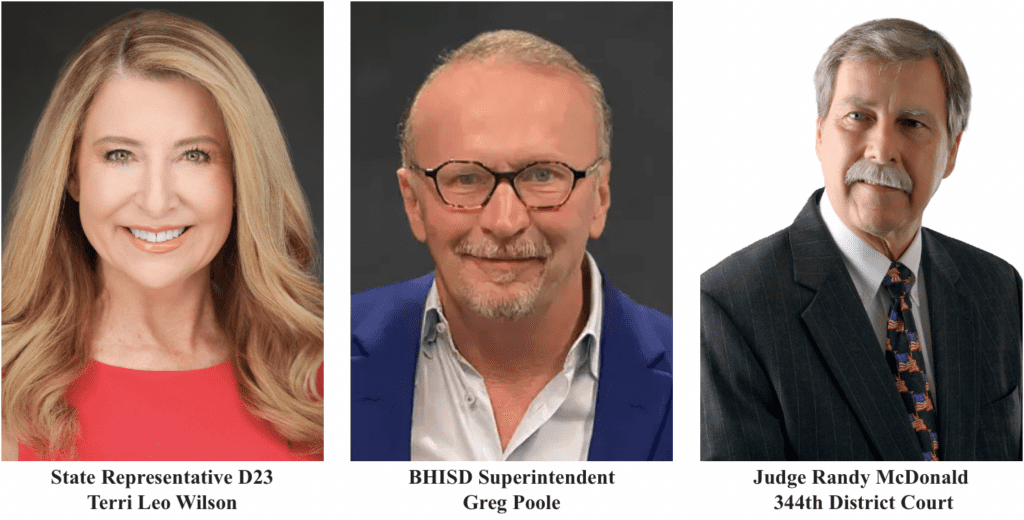
The Barber’s Hill ISD (BHISD) lawsuit against State Representative Terri Leo Wilson is far from being over much to the chagrin of BHISD. BHISD under the direction of its superintendent Greg Poole sued Leo Wilson in February 2026 for “defamation and business disparagement”. This action was a direct response to a quote by Leo Wilson to a The Texan reporter’s question of what she (Leo Wilson) thought was the motivating factor for BHISD Education Foundation director Nathan Watkins running against her. Watkins (challenger) was running against Leo Wilson (incumbent) in the GOP primary for State Representative D-23. Leo Wilson response was “I think based on what I have discovered between the ISD and the Education Foundation and Watkin’s directorship that he is running to make legal what may be illegal”. Leo Wilson was referring to the widely questionable activities of the BH Education Foundation regarding fundraising (i.e. BHISD channeling millions of dollars to the Education Foundation) and investing strategies (i.e. buying land and building apartments with foundation funds) and most notably, the very low fund distribution to the schools and teachers by the Foundation. The Foundation has over $200 million in assets and distributed only about $106,000 for school/teacher projects in the 2023-2024 school year.
In short, BHISD, under the authority of Poole, sued Leo Wilson for defamation and business disparagement and sought a temporary restraining order preventing her from speaking about any issues related to the Foundation’s management of finances, and Leo Wilson in turn, filed a motion to dismiss under the Texas Citizen Protection Act (TCPA). The Texas Citizens Participation Act (TCPA) is Texas’s anti-SLAPP law, found in Chapter 27 of the Texas Constitution and Statutes. It protects citizens from retaliatory lawsuits, often called SLAPPs (Strategic Lawsuits Against Public Participation)—designed to intimidate or silence them on matters of public concern.
The Foundation “nonsuited” its claims after Leo Wilson filed her motion to dismiss. In Texas, a “nonsuit” is the legal term for a plaintiff voluntarily dismissing their own lawsuit. Governed by Texas Rules of Civil Procedure 162, it allows a party who filed a case to end it without formal judgment. In other words, BHISD sought to drop the lawsuit against Leo Wilson.
Despite BHISD seeking to drop the lawsuit against Leo Wilson, District Court 344th Judge Randy McDonald chose to ignore the nonsuit and focused solely on a single issue “a single juror could find the alleged statement made by Leo Wilson to be “defamatory”.
In what may seem to be contradictory, McDonald agreed that “everything Wilson said with regard to this (TCPA) action has been correct” and that the court would like to see Leo Wilson compensated for attorneys’ fees. Despite the fact that the Foundation did not provide any evidence of Leo Wilson acting with malice or that the statement made by Leo Wilson curtailed any fundraising activity, McDonald denied the motion to dismiss on April 13, 2026.
Leo Wilson filed the appeal to reverse the motion because “the court abandoned the TCPA’s burden shifting framework by placing the burden on the movant to prove the claim was frivolous, rather than requiring the non-movant to present clear and specific evidence of each essential element (of the original lawsuit filed by BHISD)”.
The summary of the argument says “although the standards use similar language, they impose distinct burdens on the non-movant. Under TCPA’s burden-shifting framework, the Foundation failed to present clear and specific, non-conclusory evidence that Representative Wilson acted with malice or that it suffered damages from the challenged statement. Because the statement was not actionable as a matter of law, and because the Foundation failed to produce non-conclusory evidence of damages or of serious doubts about the truth of the alleged implication, this Court should reverse and remand for consideration of fees.
The Texas Constitution affords each person the “liberty to speak, write or publish (her) opinions on any subject. The TCPA protects citizens from “retaliatory lawsuits that seek to intimidate or silence them on matters of public concern”.
The Seabreeze Beacon will continue to provide updates on this case.