



By Gloria Way
Deep in the heart of Texas … Texas has undergone major demographic changes over the past dozen years. These changes have reshaped its electorate, increased political competition, and changed where both parties, Republicans and Democrats, find their voters.
People are moving to Texas from California, New York, Illinois, and other blue states and they are bringing with them their political ideology. Growth in technology, healthcare, education and professional employment has expanded metropolitan populations. College-educated suburban voters have become an important constituency in some elections, and younger generations are more racially and ethnically diverse than older generations. So, the central question is how population growth, immigration, urbanization, age, education, and changing voting patterns have affected the state’s political landscape.
One of the biggest changes has been the growth of Texas’s diverse population. In 2022 Hispanics comprised about 40% of Texas’ total population. Since 2012, Texas added 2.1 million Hispanic residents. The Black population has increased by about 714,000. The Asian population increased by about 588,000, and the non-Hispanic white population increased by 350,000. When you do the math, the population of Texas is dramatically losing its non-Hispanic white population.
People relocating to Texas do not all share the same political preferences. Republicans continue to win many suburban, rural and smaller metropolitan counties. The three major growth areas are the Dallas Fort Worth Metroplex, the greater Houston area, and the Austin-San Antonio area. These areas contain large and diverse electorates, and many urban counties consistently vote Democrat.
Texas has a younger and increasingly diverse population that is changing the composition of the electorate. Hispanic voters are a major voting population that has grown more Republican over the last 10 years. But growth in metropolitan suburbs have created competitive voting areas where both Democrats and Republicans have opportunities to gain support.
And then there is Chambers County. Chambers County is the 10th fastest growing county in the country and the 4th fastest growing county in the State.
Chambers County, Texas, has a diverse economy. Energy, petrochemicals, manufacturing, construction, and transportation/logistics are its dominant economic drivers. Agriculture, commercial fishing, and tourism remain important, particularly in eastern Chambers County.
Republicans lead Democrats by close to 83%. No Democrat holds a countywide position. No Democrat ran for a countywide position which means whichever Republican won in the GOP primary automatically won the seat in the general election due to no Democratic challenge.
The Hispanic population is growing in Chambers County. White non-Hispanics are a majority by about 60%. The Hispanic population is about 30%, and the Black population is roughly 9%.
As is apparent, rural Texas tends to be red, and the urban, metropolitan areas are increasingly staying blue.
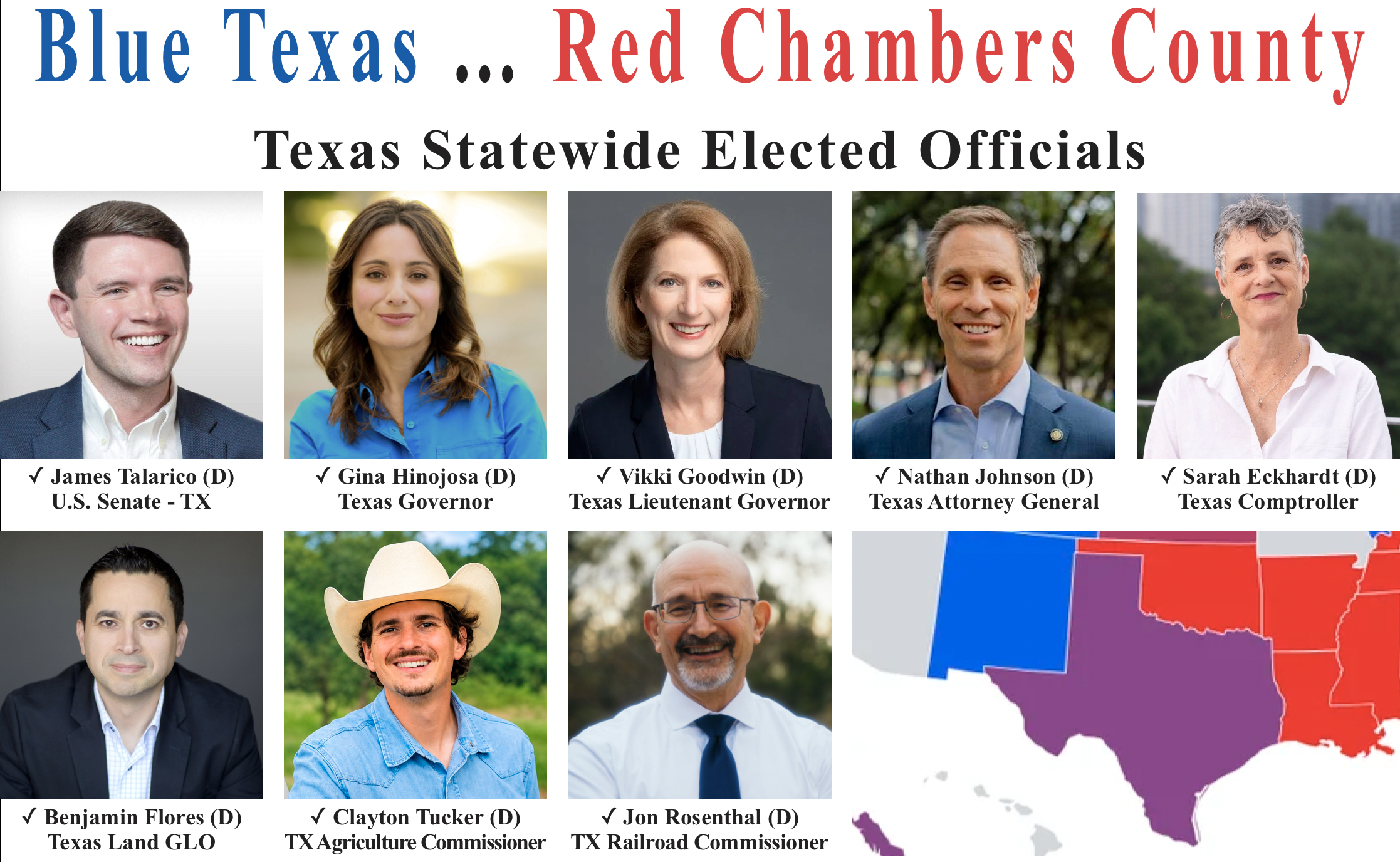
We can call Texas purple. The statewide offices all turned blue but they must work with the state representatives and state senators’ majorities which are red. And vice versa.
It will be an interesting four years.